
Switzerland County Criminal Court Records
A criminal court record begins when a charging document is filed with the court. In Switzerland County, adult criminal case records are tied to the Switzerland Circuit Court and maintained through the Circuit Court Clerk's records function. The file can include the charging information, probable-cause material where public, appearances, bond orders, warrants, motions, plea records, hearing entries, sentencing orders, fines, costs, restitution, and probation conditions.
The full criminal case file is broader than the arrest side, which concerns custody, booking, and jail status. Formal court charges and later outcomes appear in the criminal case. For the arrest-to-charge distinction, use the Switzerland County arrest records and charges page; for all case types, use the general court records page.
The image below comes from the official Switzerland County Prosecutor's Office page.
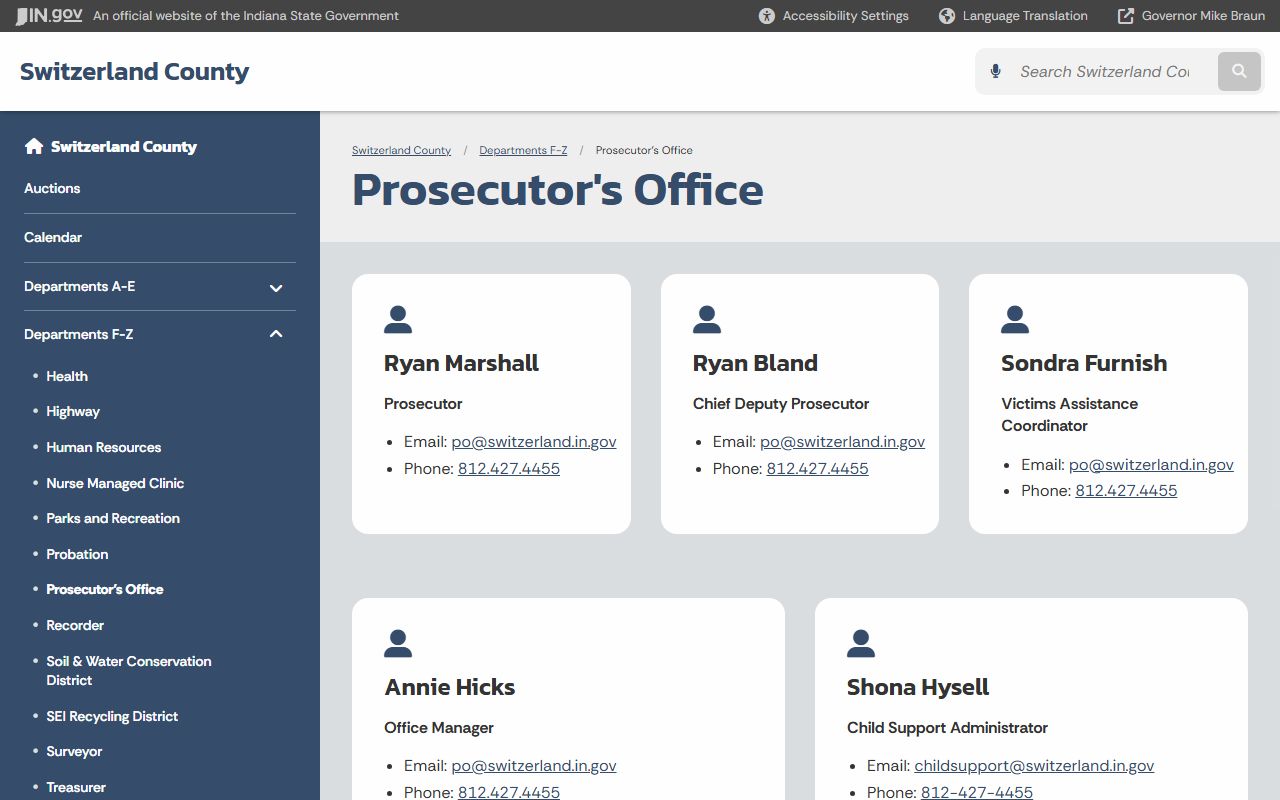
The prosecutor's office is central to criminal court records because the prosecutor decides whether and how charges are filed for the State of Indiana.
Who Files Switzerland County Criminal Charges
Indiana uses the title Prosecutor or Prosecuting Attorney, not District Attorney. The official county prosecutor page lists Ryan Marshall as Prosecutor, with the office at 212 West Main Street in Vevay. The prosecutor represents the State of Indiana and prosecutes violators of state statutes in courts with criminal jurisdiction within the judicial circuit. That role is the bridge between an arrest allegation and a filed criminal court case.
The prosecutor's office also lists a Chief Deputy Prosecutor, Victims Assistance Coordinator, Office Manager, and Child Support Administrator. Victim assistance is part of the local office structure, but the criminal court record itself remains the court case file. Child-support work is a separate prosecutor function and should not be confused with adult criminal prosecution.
Switzerland County Prosecutor's Office
212 West Main Street
Vevay, IN 47043
812-427-4455
po@switzerland.in.gov
Monday-Friday, 8:00am-4:30pm; closed 12:00pm-1:00pm
The image below comes from the official Switzerland County Prosecutor's Office site.
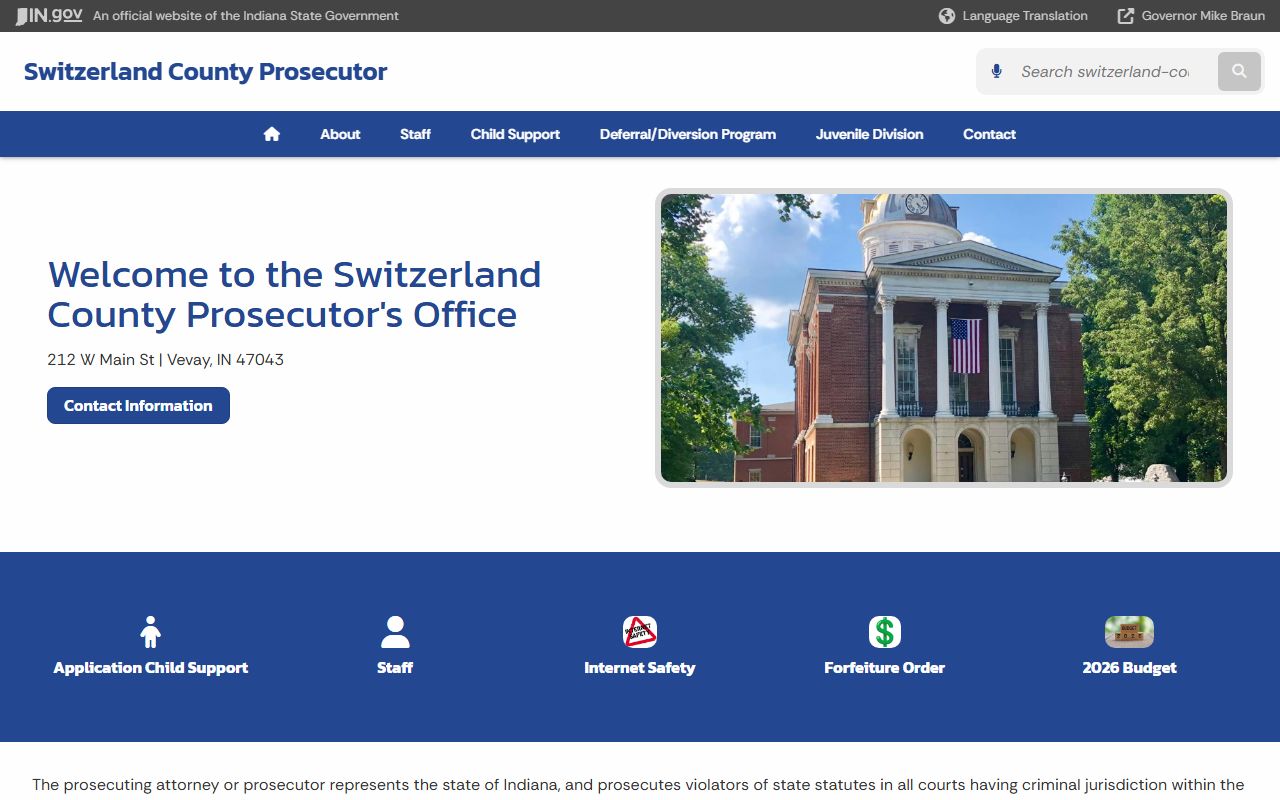
That source explains the prosecutor's criminal jurisdiction and supports using "Prosecutor" instead of "District Attorney" for Switzerland County criminal court records.
Search Switzerland County Criminal Cases
Use Indiana MyCase for public criminal case summaries. Search by defendant name, cause number, attorney, or other available filters. The county's active court identifier is 78C01 Switzerland Circuit Court, and using that identifier or a county filter can help keep results local. MyCase can show public case events, charges, hearing dates, pleas, dispositions, financial obligations, and sentence information when those fields are available.
- Open MyCase and use the case or name search tab.
- Enter the cause number if known, or search by defendant name with Switzerland County or court filters.
- Open the criminal case summary and review the charges, chronological case summary, hearings, and status.
- Check each count separately because one case can include several charges with different outcomes.
- Ask the Circuit Court Clerk for certified sentencing orders or documents not available online.
MyCase does not replace the official record. The Circuit Court Clerk remains the source for certified copies, older criminal files, documents not posted online, and questions about local copy process. The clerk's page also warns that a case number is needed for paperwork processing, so a MyCase search is often the first step before a records request.
Switzerland County Criminal Case Flow
Criminal court records are easier to read when the case flow is clear. A law-enforcement arrest or investigation may occur first, but the criminal case record starts in court when formal charges are filed. The docket then tracks hearings, motions, plea events, trial activity, disposition, sentencing, and later probation or compliance entries.
Case flow: Charges Filed › Initial Hearing or Arraignment › Pretrial and Motions › Plea or Trial › Disposition › Sentencing
| Stage | What Happens |
|---|---|
| Charges filed | The prosecutor files an information or other charging document and the court opens a cause number. |
| Initial hearing or arraignment | The defendant is advised of rights, charges, possible penalties, counsel issues, and bond conditions. |
| Pretrial and motions | The docket may show appearances, discovery events, continuances, motions, orders, and hearing settings. |
| Plea or trial | The case resolves by guilty plea, trial verdict, dismissal, or another disposition. |
| Sentencing | The court records the sentence, fines, costs, probation terms, restitution, and other conditions where public. |
Criminal case flow varies by charge level and case facts. A dismissed count, amended count, or reduced charge can stay visible in the event history even when the final outcome is different from the first allegation.
What Switzerland County Criminal Records Show
A public criminal court record can show both the identity of the case and the substance of its court action. For Switzerland County criminal court records, the cause number, court, filing date, defendant, charge count, offense name, statute, level, plea, finding, disposition, sentence, probation term, and financial obligations are the fields to review most closely.
| Field | What It Shows |
|---|---|
| Cause number | The court case identifier used for MyCase, clerk requests, and filings. |
| Defendant | The person charged in the criminal case, subject to public access rules. |
| Charge count | Each separate alleged offense filed in the case. |
| Statute and level | The Indiana code section and offense classification tied to the charge. |
| Plea or finding | How the defendant answered the charge and whether guilt was found. |
| Disposition | The final outcome for the case or count, such as guilty, dismissed, or not guilty. |
| Sentence | Jail, probation, fines, costs, restitution, and other terms where public. |
The image below comes from the IPAC Switzerland County prosecutor contact page.
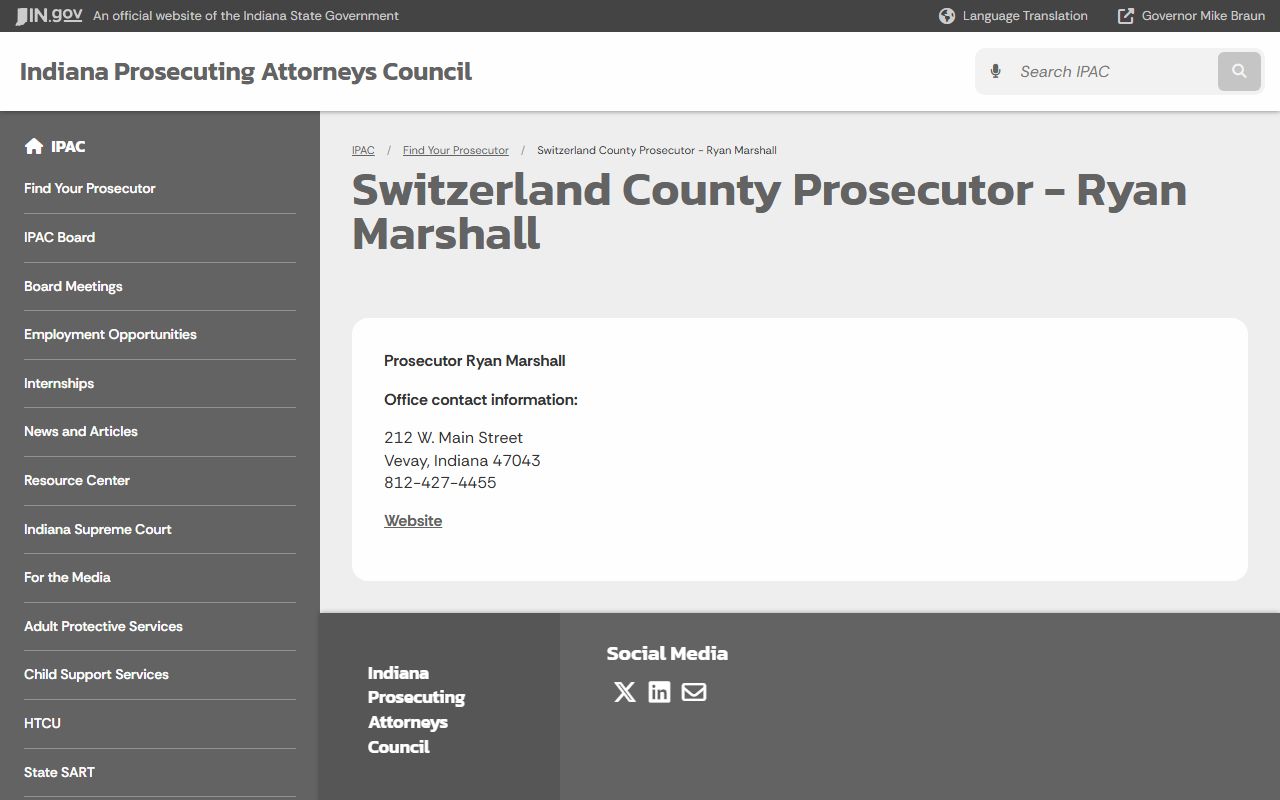
That contact source reinforces the local prosecutor role when reading the charge and disposition parts of a Switzerland County criminal court record.
Charges vs Convictions
A charge is an accusation filed in court. A conviction is a final finding or guilty plea. Switzerland County criminal court records can show charges that were dismissed, reduced, amended, or resolved differently by count. Read the disposition for each count before treating a charge as a conviction.
| Point | Charge | Conviction |
|---|---|---|
| Meaning | An accusation filed by the prosecutor. | A guilty plea, guilty finding, or verdict accepted by the court. |
| Where it appears | Charging document, case summary, and charge list. | Disposition, judgment, sentencing, and financial entries. |
| Can change | May be amended, reduced, dismissed, or dropped. | May later be expunged or otherwise restricted if eligible. |
Switzerland County Bonds and Warrants
Bond and warrant events may appear in a criminal case summary when public. The Switzerland County Sheriff's jail information says any inmate with bond set by the judge or bond schedule is eligible to bond out, cash-only bonds can be paid directly to the jail, exact cash is required, and personal checks are not accepted. That jail payment process is separate from the court record, but bond orders can be part of the criminal file.
Indiana research also notes there is no statewide public website for searching all arrest warrants and that MyCase does not function as a warrant search. A public warrant event may appear inside a criminal case summary when a warrant has issued and is not confidential. Current custody questions go to the jail, not the criminal case docket.
Note: A public warrant event in a case summary is not the same as a live statewide warrant search.
Probation in Criminal Court Records
Probation is a court-ordered supervision term that can appear after conviction or as part of a sentence. Switzerland County's official probation page lists the office at the courthouse, Chief Probation Officer Jeff Theetge, phone 812-427-4450, email cpo@switzerland.in.gov, and fax 812-427-4453. The criminal court record may show that probation was ordered, modified, revoked, or completed where public.
The image below comes from the official Switzerland County Probation page.
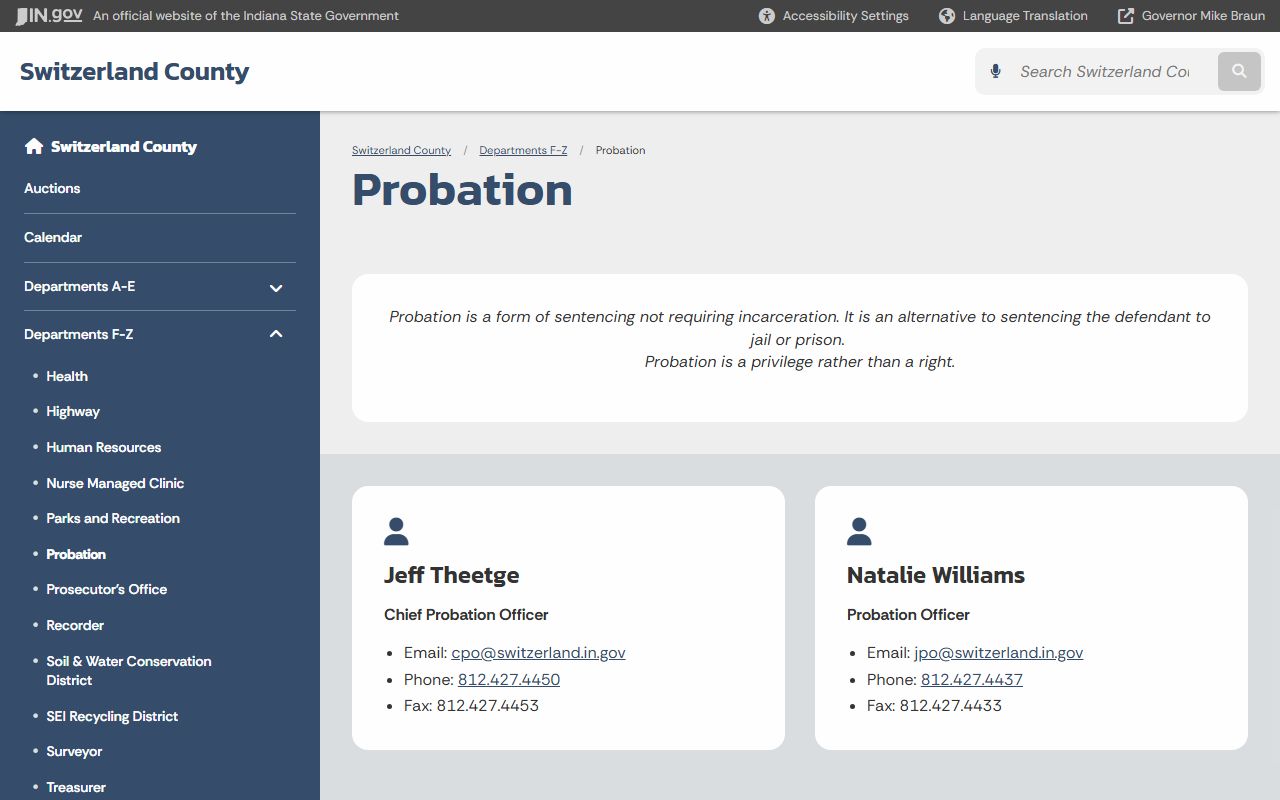
Probation entries are part of the sentence-reading process, but supervision details can still be limited by court rules or agency practice.
Sealed vs Expunged Criminal Records
Indiana expungement law can limit public access to eligible arrest, charge, and conviction records. The process is handled by petition in the court with jurisdiction over the record. For Switzerland County adult criminal matters, that generally means using the Switzerland Circuit Court connection, identifying every eligible arrest, charge, and conviction, and following IC 35-38-9 requirements.
| Point | Sealed or restricted | Expunged under Indiana law |
|---|---|---|
| Public view | Public access is limited by rule, statute, or court order. | Public access is limited as the expungement order directs. |
| Who may still see it | Authorized court, law-enforcement, or criminal-justice users may retain access. | Authorized agencies may retain access for allowed purposes. |
| Eligibility | Depends on the record type and the legal basis for restriction. | Depends on offense level, outcome, waiting period, costs, pending cases, and prior relief. |
The image below comes from Indiana Code Title 35.
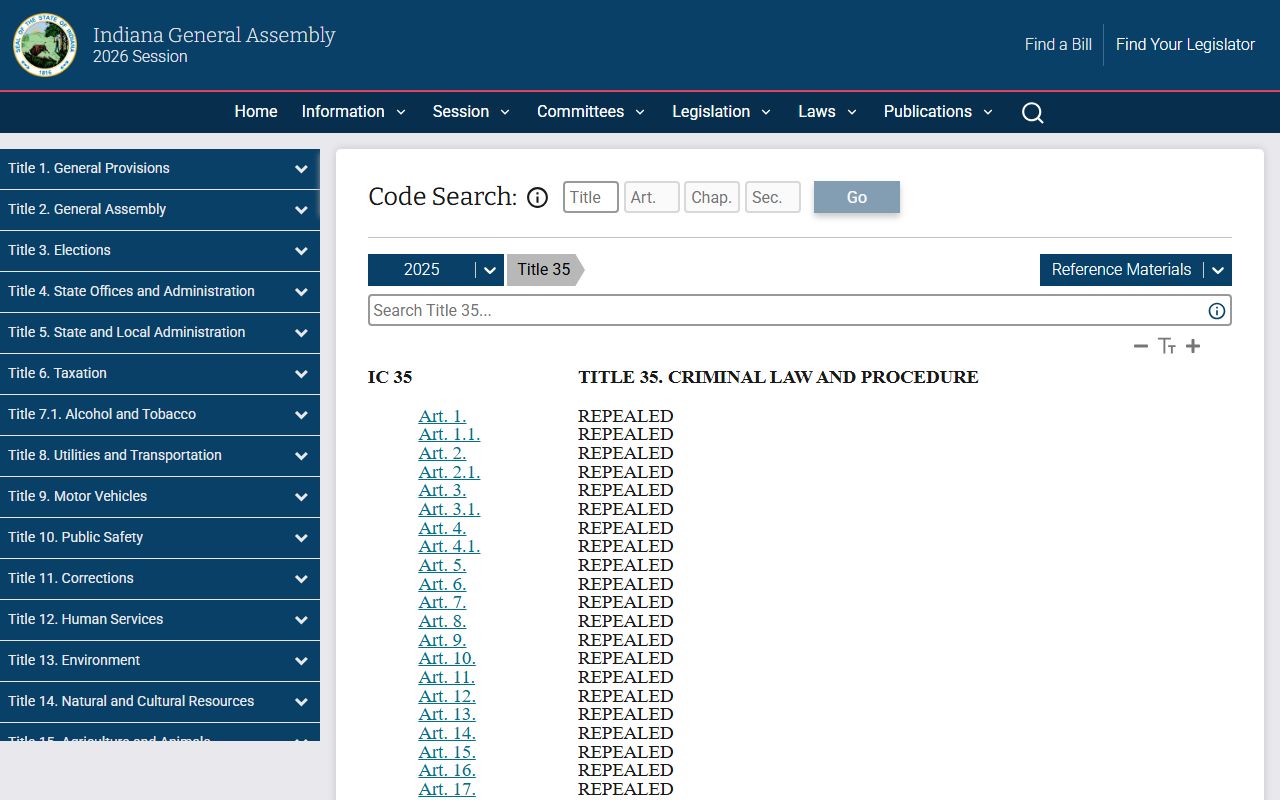
Title 35 is the state-law source for criminal procedure and expungement context used when assessing restricted Switzerland County criminal court records.
Public Access to Criminal Records
Public access to Switzerland County criminal court records is controlled by Indiana court access rules, not by a county-only database policy. Indiana Administrative Rule 9 and the Access to Court Records Rules explain that many case records are public while specific information or case types may be excluded. Non-court sheriff administrative records are subject to the Indiana Access to Public Records Act, with law-enforcement and confidentiality exceptions.
Juvenile cases, adoption material, mental-health information, confidential addresses, minor information, full dates of birth, account numbers, social security numbers, and sealed or expunged records are not ordinary public search results. A public criminal court record should still be verified with the Circuit Court Clerk before it is used for court, licensing, employment, housing, or any formal decision.
Important: Criminal case lookup is not a consumer report and should not be used for FCRA-regulated decisions.